Working Towards a More Inclusive Future
The inaugural “Women of CTAO” event was held in Bologna on 11 February 2019, in celebration of the International Day of Women and Girls in Science. Since then, it has grown into a flagship initiative that brings together women from across the CTAO community.
“Women of CTAO” showcases experts from a wide range of disciplines—including astrophysics, engineering, outreach and administration—who share their academic journeys, professional achievements, and personal experiences in science, as well as their contributions to the CTAO. Events have been hosted at CTAO sites and online. To watch online editions, go to the dedicated playlist on YouTube.
Join us at the next “Women of CTAO” event to hear these stories firsthand, connect with the community, and be part of the movement shaping a more inclusive future in science!
Next Event: 16 May 2026, La Palma, Canary Islands, Spain – more details coming soon!


Gender equity in Science, Technology, Engineering, and Mathematics (STEM) goes far beyond simply achieving numerical parity of women in technical fields. The pursuit of this equity is about ensuring that women and girls have exactly the same opportunities for access, participation, development, and leadership, actively dismantling the systemic biases and structural barriers embedded within these disciplines. Therefore, “Women of CTAO” is part of a broader global effort to address gender inequity and the persistent underrepresentation of women in science.
Nowadays, this objective is a non-negotiable pillar in the global agenda of any international organisation, including the CTAO. Within the United Nations’ Sustainable Development Goals, this perspective of inclusion is protected by SDG 5, which directly targets gender equality, and SDG 4, which aims for inclusive, quality education for all. Beyond the moral imperative of offering equal opportunities to everyone, gender equity is also a binding regulatory requirement in many cases. For instance, the European Union has incorporated this dimension as a sine qua non condition for accessing its research and innovation funding instruments, thereby compelling organisations to actively pursue this goal.
The Current Landscape for Women in Scientific and Technical Careers
Globally, looking broadly across all scientific disciplines (including, for example, health sciences), we are approaching numerical parity in higher education: women account for 45-55% of bachelor’s and master’s degree students, and 44% at the PhD level. However, when transitioning into professional research, this value dropped to 33% in 2018 (UNESCO Science Report, 2021).
In technical fields such as IT, computing, physics, mathematics, and engineering, women are still significantly underrepresented. Crucially, these are the very fields driving the current industrial revolution (Industry 4.0), which encompasses digital transformations towards smart technologies like AI, Big Data, and robotics. The UNESCO Science Report gathers a specific example: “In the EU, for instance, more than half of men earning degrees in information technology (IT) end up working in digital jobs, compared to one-quarter of women (UNESCO and Equal Skills Coalition, 2019).” Furthermore, studies show that women abandon technical fields at higher rates than men, frequently citing working conditions, lack of access to creative roles, or career stagnation as primary reasons.
At the European level, the trend shows steady, encouraging growth. Recent data indicates that the number of women working as scientists and engineers in the EU rose to 7.9 million in 2024 (from 3.4 million in 2008), representing 40.5% of the total workforce in these fields (Eurostat, 2026). Unfortunately, when focusing in the academic field (including, for example, research institutions and universities), women’s representation is considerably lower among all tertiary education and academic staff in STEM. In fact, even though historical data reveals progress, considerable work remains, with two distinct dynamics still highly prevalent (She Figures, 2024): The“leaky pipeline,” which results in a continuous loss of female talent during the transition from postdoctoral stages to academic tenure; and, concurrently, the “glass ceiling” that obstructs equitable access to top leadership positions.
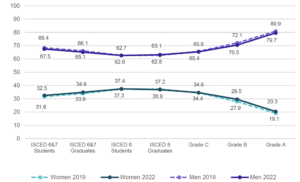
Figure: Proportion (%) of women and men in a typical academic career in science and engineering, students and academic staff, 2019-2022. Credit: She Figures, 2024
To tackle the root of the problem, UNESCO provided highly detailed guidelines in its 2017 report, “Cracking the Code.” One fundamental pillar that is especially poignant from a communications perspective is the creation of role models from childhood. As the American astronaut Sally Ride famously said, “You can’t be what you can’t see.” It is essential to increase the visibility of women’s contributions in STEM to counteract early gender stereotypes and provide girls with relatable figures. The Women of CTAO event is designed to advance these goals by highlighting and celebrating the vital contributions of female colleagues to the development of the world’s largest gamma-ray observatory, while also raising broader awareness of their impact.
Past Editions
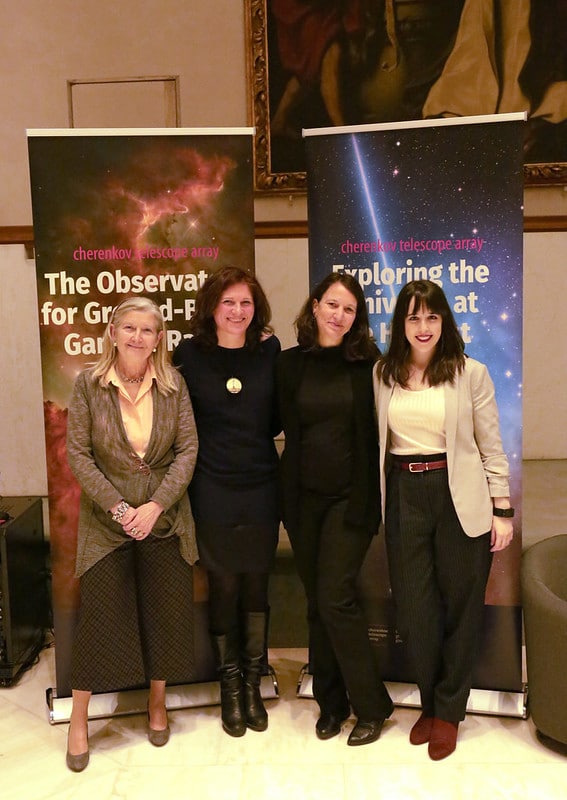
Location: Pinoteca Nazionale di Bologna, Bologna, Italy
Speakers: Emma de Oña Wilhelmi (IEEC-CSIC Barcelona, DESY Zeuthen), Patrizia Caraveo (University of Pavia), Chiara Montanari (CTAO)
More Information: https://www.ctao.org/news/first-women-cta-meeting/
Location: Scuderia | Future Food Urban Coolab, Bologna, Italy
Speakers: Carla Aramo (INFN), Ambra Di Piano (University of Bologna), Roberta Zanin (CTAO)
More Information: https://www.ctao.org/news/women-cta-meeting-2/

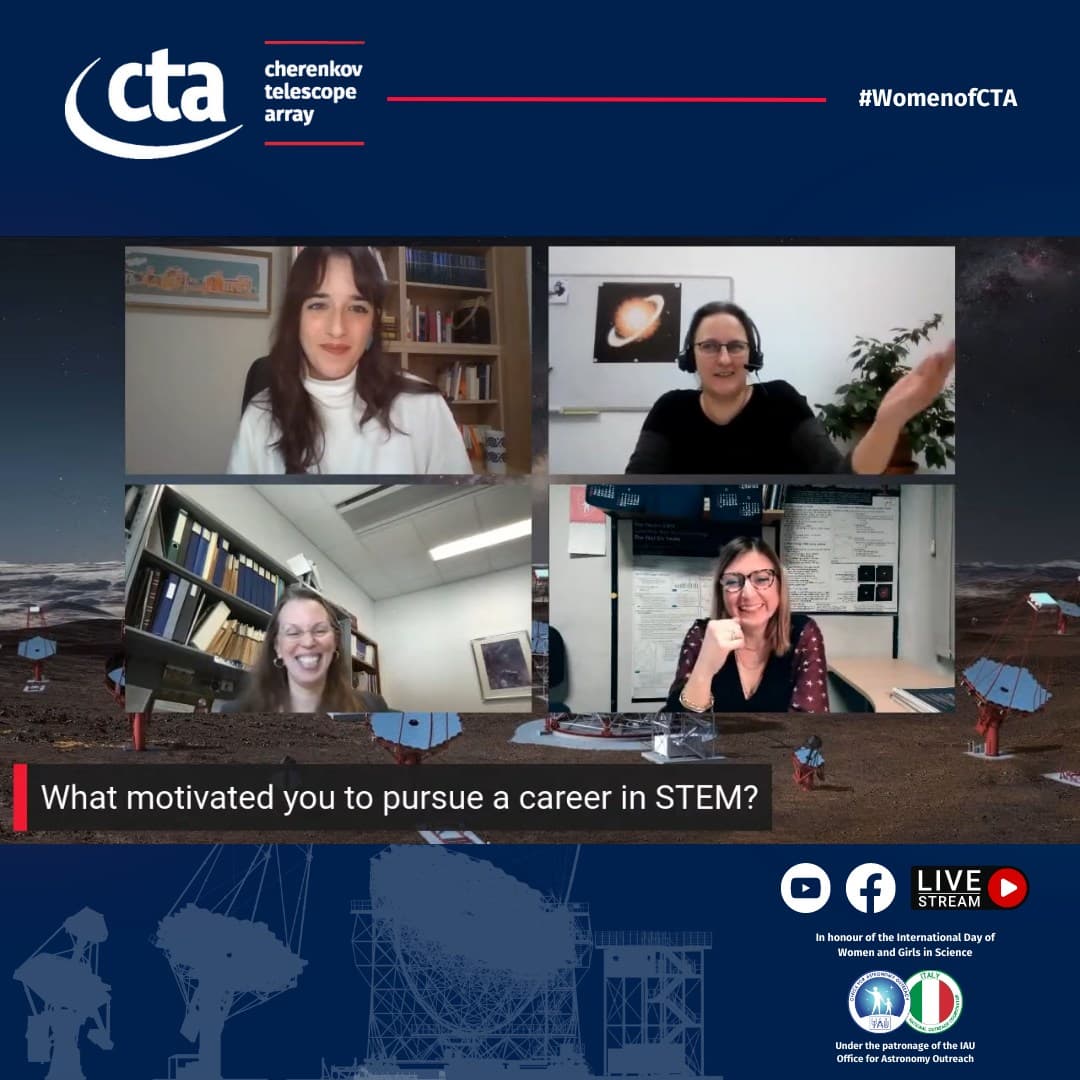
Virtual Event in English
Speakers: Elina Lindfors (University of Turku), Mireia Nievas (IAC), Leslie Paige Taylor (University of Wisconsin-Madison)
More Information: https://www.ctao.org/news/women-cta-meeting-3/
Watch on YouTube: https://www.youtube.com/live/Ryn0deLc9v0?si=Mc5ZYgn1Si24P3S2

Virtual Event in English
Speakers: Anna Wolter (INAF), Heide Costantini (Aix-Marseille University), Judit Pérez (IFT)
More Information: https://www.ctao.org/news/women-cta-meeting-4/
Watch on YouTube: https://www.youtube.com/live/1wthDpESB90?si=kdqZ0cMadCPWLgEh

Virtual Event in English
Speakers: Lucy Fortson (University of Minnesota), Elisabetta Bissaldi (Politecnico di Bari and Italian National Instituto for Nuclear Physics, INFN) and Heike Prokoph (DESY)
More Information: https://www.ctao.org/news/women-cta-meeting-5/
Watch on YouTube: https://www.youtube.com/live/Yg8TmH9887k?si=At7oVN-dr6EvZkyX
Upcoming Events
Interested in participating or co-hosting an event? Contact the CTAO Communications Office.