To cover its broad energy range, from 20 GeV to 300 TeV, the CTAO will rely on three different types of telescopes: the Large-Sized Telescope (LST), the Medium-Sized Telescope (MST) and the Small-Sized Telescope (SST). Each type is designed to observe a specific part of this energy range, allowing the Observatory to capture gamma rays across an exceptionally wide spectrum.
Specifically, the MSTs are optimised for the Observatory’s core energy range, from 80 GeV to 50 TeV, with a total of 23 telescopes planned for the two CTAO array sites, in La Palma and Chile. The currently approved MST design features a single 86 m² reflective surface that collects and focuses Cherenkov light onto the camera. However, an alternative design is also being explored: the Schwarzschild-Couder Telescope (SCT).
Unlike the established MST design, the SCT uses two mirrors to focus incoming light. This innovative optical configuration aims to produce sharper images, providing greater detail and improving the detection of faint gamma-ray sources.
Since 2006, research institutes in the United States have been at the forefront of SCT development, working alongside MST and SST collaborators and research institutions in Germany, Italy, Japan, and Mexico. In recent months, the teams have been focusing on upgrading the camera of the prototype Schwarzschild-Couder Telescope (pSCT), located at the Fred Lawrence Whipple Observatory in Arizona. These efforts have already led to new achievements, marking another important step forward in the development of this alternative telescope design.
New Camera Technology
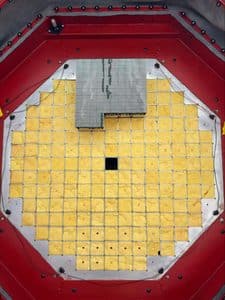
One of the most distinctive features of the SCT is its camera, which uses thousands of silicon photomultipliers or SiPMs, highly sensitive semiconductor devices (pixels) capable of detecting individual photons. The camera has a modular design, allowing individual sections to be installed, replaced, and upgraded independently. Fully equipped, it consists of 177 modules arranged in nine sectors, containing a total of 11,328 pixels to cover an 8° field of view.
In spring 2026, the SCT team installed 22 upgraded camera modules, comprising a total of 1,408 pixels. This involves introducing camera modules that feature more advanced sensors and new, lower-noise electronics. Rather than simply increasing the number of pixels, the upgrade is focused on improving the camera’s overall detection and readout capabilities, resulting in cleaner, higher-resolution images of gamma-ray and cosmic-ray-induced air showers.
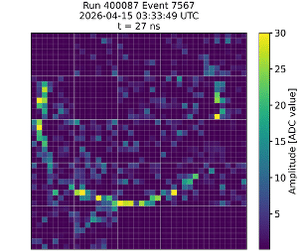
Interestingly, these modules were installed at the edge of the camera, allowing the team to investigate the telescope’s performance up to 4° off-axis. This helps assess the telescope’s ability to detect sources located as far as 4° from the centre of its field of view (half its full 8° diameter field of view). Early observations already provided encouraging results, revealing sharp rings produced by muons reaching ground level, which are particularly useful for validating the camera’s trigger system, readout electronics, and optical imaging resolution.
Probing New Capabilities in a Real Test
A particularly exciting milestone came in April 2026, when the pSCT took part in a coordinated observing campaign targeting Markarian 421, a blazar powered by a supermassive black hole. Observing simultaneously with the VERITAS telescopes and NASA’s Imaging X-ray Polarimetry Explorer (IXPE), the pSCT detected the source independently with a statistical significance of 7.8 sigma, using just 2.75 hours of data. Remarkably, the source was located approximately 2.7° from the centre of the camera’s field of view.
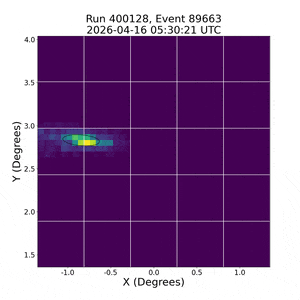
Each frame of the animation shows a time-integrated image of a single gamma-ray candidate detected by the pSCT during observations of Markarian 421. X and Y coordinates are measured relative to the centre of the field of view. Credit: SCT Collaboration.
Why is this result remarkable? In telescopes with a single-mirror optical design, image quality tends to deteriorate towards the edges of the field of view, making it more difficult to reconstruct atmospheric showers accurately. The SCT’s dual-mirror optical system is designed to minimise these distortions, preserving image quality even far from the centre. The detection of Markarian 421, therefore, provides an important demonstration of one of the potential advantages of the Schwarzschild-Couder design: its improved performance when observing sources away from the optical axis.
“This observing campaign and analysis not only serve as validation of the upgraded camera and further evidence of the SCT design’s efficacy, but also demonstrate one of the key advantages that the SCT has over single-mirror telescopes: the improved image quality of its off-axis observations, even far from the centre of the camera,” explains Luca Riitano, researcher at UW–Madison, who publicly presented these results at the IceCube Particle Astrophysics Symposium in October 2026.
The camera upgrade, funded by the U.S. National Science Foundation, along with international partners in Italy, Germany, and Japan, is expected to be completed in 2027, when all 177 modules are installed. The fully upgraded camera will feature more than 11,000 pixels across an 8° field of view, opening new opportunities to test the potential of the Schwarzschild-Couder design for the next generation of ground-based gamma-ray astronomy.