Large But Nimble
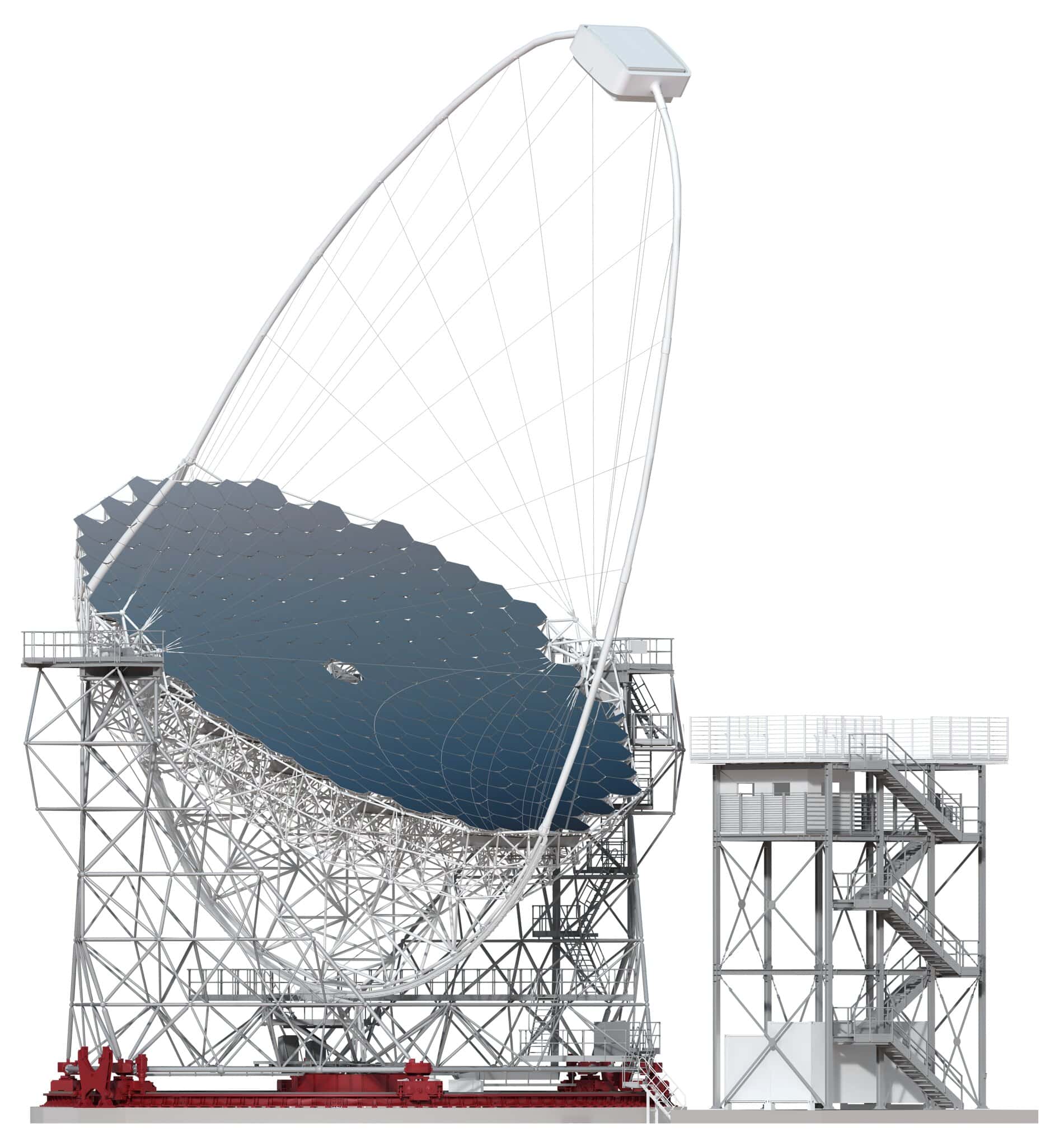
Don’t be deceived by the enormous size of these telescopes – the LSTs are very nimble to capture brief, low-energy gamma-ray signals. Even at 42-45 m tall and more than 100 tonnes, the LSTs can reposition between any two points in the sky within 20-30 seconds. Both the repositioning speed and the low-energy threshold provided by the LSTs are critical for the CTAO’s studies of galactic transients, high redshift active galactic nuclei, and gamma-ray bursts. The LSTs will expand the science to reach cosmological distances and fainter sources. There are two different designs for the LSTs due to site characteristics. While the cameras are the same, the LSTs on CTAO-North use a relatively lightweight design (45 m tall, 100 tonnes), and the CTAO-South LSTs (42.5 m tall, 160 tonnes) are designed to withstand earthquakes that are typical to the Atacama Desert.
The Camera
The LST camera weighs less than two tonnes and uses 1855 photomultiplier tubes (PMTs) as photosensors to convert the light into electrical signals. The camera has a total field of view of about 4.3 degrees and has been designed for maximum compactness and low weight, cost and power consumption while providing optimal performance at low energies.
The Reflector
The LST’s reflector is 23 m in diameter and parabolic in shape. The LSTs for CTAO-North use a tubular structure made of reinforced carbon fibre and steel tubes to support the camera, while LSTs on CTAO-South will use a sturdier structure made of steel beams. A massive reflective surface of 400 m2 collects and focuses the Cherenkov light into the camera, where the light can be digitised and processed.
The Rail and Bogies
Both LST designs are equipped with a circular 23 m diameter rail and six wheel bogies that they use to quickly spin to any point to in the sky in less than 30 seconds.
CTAO-North LST Rendering (Credit: Gabriel Pérez Díaz, IAC)